Should You Really Be Worried About Spiders in Your Home?
A spider appears in the corner of your ceiling.
For many people, the immediate reaction is simple:
“Get it out of the house.”
But spiders are different from many of the pests discussed on this blog.
Most spiders are predators rather than contaminating pests. They feed on insects and other small arthropods, meaning spiders can actually play a useful role in natural ecosystems.
So why would you ever need spider control?
Because there is an important difference between a harmless spider outdoors and persistent spider activity throughout a home, garage, storage area, or business property.
Let’s separate the myths from the actual concerns.
First: Are All Spiders Dangerous?
No.
The vast majority of spiders people encounter are not considered medically significant to humans, and spiders generally do not seek out people to attack.
Bites may occur when a spider is accidentally trapped, pressed against the skin, disturbed, or handled.
For many spider species, a bite—if it occurs—may produce relatively minor local symptoms.
However, certain spiders deserve more caution.
Which Spiders Should California Residents Know About?
California contains many spider species, but homeowners do not need to memorize every one.
A few groups are worth understanding.
🕷️ Black Widow Spiders
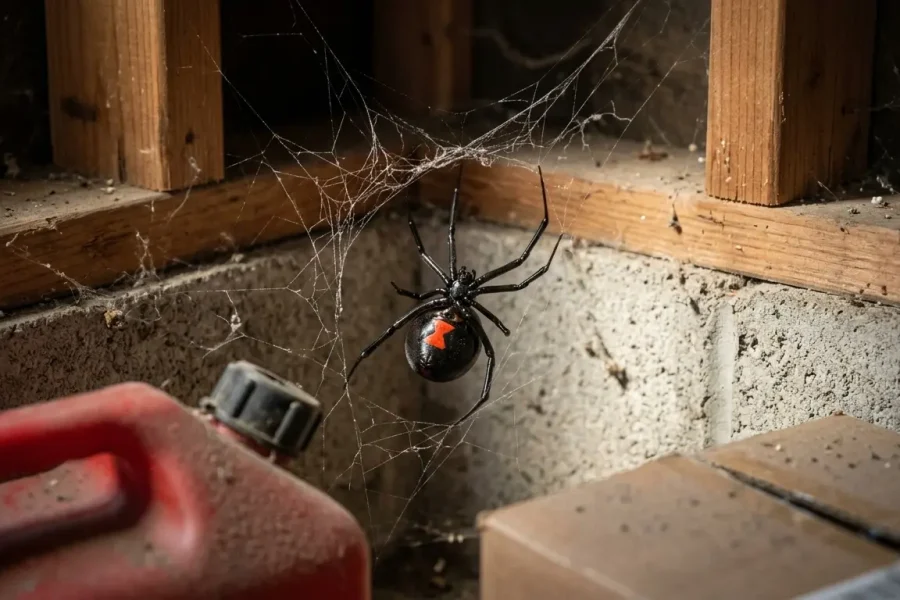
Black widows are among the spiders of greatest medical importance in the United States.
Adult female western black widows are typically shiny and dark, often with a reddish hourglass-type marking on the underside of the abdomen.
Their venom affects the nervous system, and bites can cause symptoms such as significant pain and muscle cramping. Suspected serious bites should receive appropriate medical attention.
🕷️ Brown Widow Spiders
Brown widows can also occur in parts of California.
They generally have mottled brown coloration and can be associated with sheltered outdoor locations around human structures.
Correct identification is important because coloration alone is not enough to identify every spider accurately.
🕷️ House and Cobweb Spiders
Various non-dangerous spiders may establish webs around corners, garages, storage spaces, windows, and other relatively undisturbed areas.
Their presence may be undesirable, but they should not automatically be treated as medically dangerous.
🕷️ Jumping Spiders
These small, active hunters are known for their characteristic jumping movement and relatively large forward-facing eyes.
They do not rely on a typical capture web in the same way many web-building spiders do and are generally not considered a major human health threat.
What About the Brown Recluse?
This deserves special attention because brown recluse spiders are frequently blamed for bites and skin lesions.
Brown recluse spiders are not established as a native, widespread California spider population.
California does have other Loxosceles species in some areas, particularly desert-associated species, but identifying a spider—or diagnosing a skin lesion—as “brown recluse” based only on appearance or symptoms can be misleading.
If a potentially significant bite is suspected, medical evaluation is more appropriate than trying to identify the cause from an internet photo.
Why Are Spiders Coming Into Your Property?
Now we reach the most useful pest-control question.
Spiders generally go where conditions support survival.
And one major factor is:
Other insects.
If your property has abundant flies, mosquitoes, moths, ants, or other arthropods, it may provide spiders with a steady food supply.
This means that a spider problem can sometimes be a symptom of a broader pest problem.
Spiders may also find shelter in:
- Garages
- Basements
- Storage rooms
- Attics
- Eaves
- Window frames
- Outdoor furniture
- Wood piles
- Landscaping
- Undisturbed corners
Exterior lighting that attracts flying insects can indirectly create productive hunting areas for spiders as well.

Do Spiders Spread Diseases?
This is another important difference from flies, mosquitoes, and rodents.
Spiders are not generally considered vectors that spread infectious diseases between humans in the way mosquitoes or some other pests can.
The principal health concern is instead associated with venomous bites from medically significant species, along with individual reactions to bites.
Therefore, a spider-control article should not exaggerate disease transmission simply to make spiders sound more dangerous.
Accurate pest information builds greater trust.
So Why Control Spiders At All?
There are several legitimate reasons.
Repeated Indoor Activity
Finding spiders throughout multiple rooms can indicate favorable conditions or easy access points.
Web Accumulation
Webs around entrances, windows, ceilings, exterior fixtures, or customer-facing business areas can become an appearance and maintenance problem.
Potentially Significant Species
A suspected black widow in an area frequently used by children, pets, employees, or customers deserves greater caution than a harmless garden spider outdoors.
Underlying Insect Activity
A large spider population can indicate that other insects—their food supply—are also abundant.
Comfort
Even harmless spiders can make occupants uncomfortable when they repeatedly appear in bedrooms, bathrooms, closets, or living areas.
The Smarter Spider-Control Strategy: Control the Environment
Spider management should not necessarily begin with “spray every spider.”
A more useful strategy asks:
Why is this property attractive to spiders?
Then address those conditions.
Reduce Their Food
Managing flies, mosquitoes, and other insects can make the property less attractive to predatory spiders.
Remove Webs
Regularly removing accessible webs can discourage repeated establishment in some areas.
Reduce Clutter
Boxes, stored materials, and undisturbed items provide potential hiding places.
Wear appropriate protection when handling long-undisturbed stored materials in spider-prone areas.
Seal Entry Points
Repair damaged screens and address gaps around doors, windows, utility penetrations, and other possible access routes.
Review Exterior Lighting
Where practical, consider how outdoor lighting may be attracting flying insects close to doors and windows.
Maintain Landscaping
Vegetation touching the building and clutter immediately beside structures can create additional habitat for insects and spiders.
When Does a Spider Problem Need Professional Attention?
Consider professional Spider Control when:
✓ Spider activity is widespread or recurring
✓ Large numbers of webs repeatedly appear
✓ You suspect medically significant spiders
✓ Spiders are appearing in frequently occupied areas
✓ Other insect activity is also high
✓ You cannot determine where spiders are entering
✓ Household prevention has not reduced the problem
Professional pest management can evaluate both the spiders and the conditions supporting them.
That distinction is important.
A Better Balance Between Protection and Nature
Spiders have a legitimate ecological role. Outdoors, many help naturally regulate insect populations.
The goal of responsible Professional Pest Management therefore does not have to be eliminating every spider from the environment.
For a home or business, the practical goal is to reduce unwanted spider activity where people live and work, manage higher-risk situations, limit entry points, and address the insects that may be attracting spiders in the first place.
Professional Spider Control From Pest Control Elite
If spiders are repeatedly appearing throughout your property, simply removing one web at a time may not address the reason they keep returning.
Pest Control Elite provides professional Spider Control and Pest Control Services in California for residential and commercial properties. We can help identify spider activity, potential entry points, pest conditions, and appropriate control options for your property.
Too Many Spiders Around Your Property?
Contact Pest Control Elite to schedule a pest inspection and discuss a professional spider-control solution.
Related Services: Spider Control | Pest Inspection | Residential Pest Control | Fly Control | Mosquito Control | Recurring Pest Control
Still have any question?
call us
+1 (833) 659-0907
1416 N San Pablo Ave, Fresno, CA 93728, USA